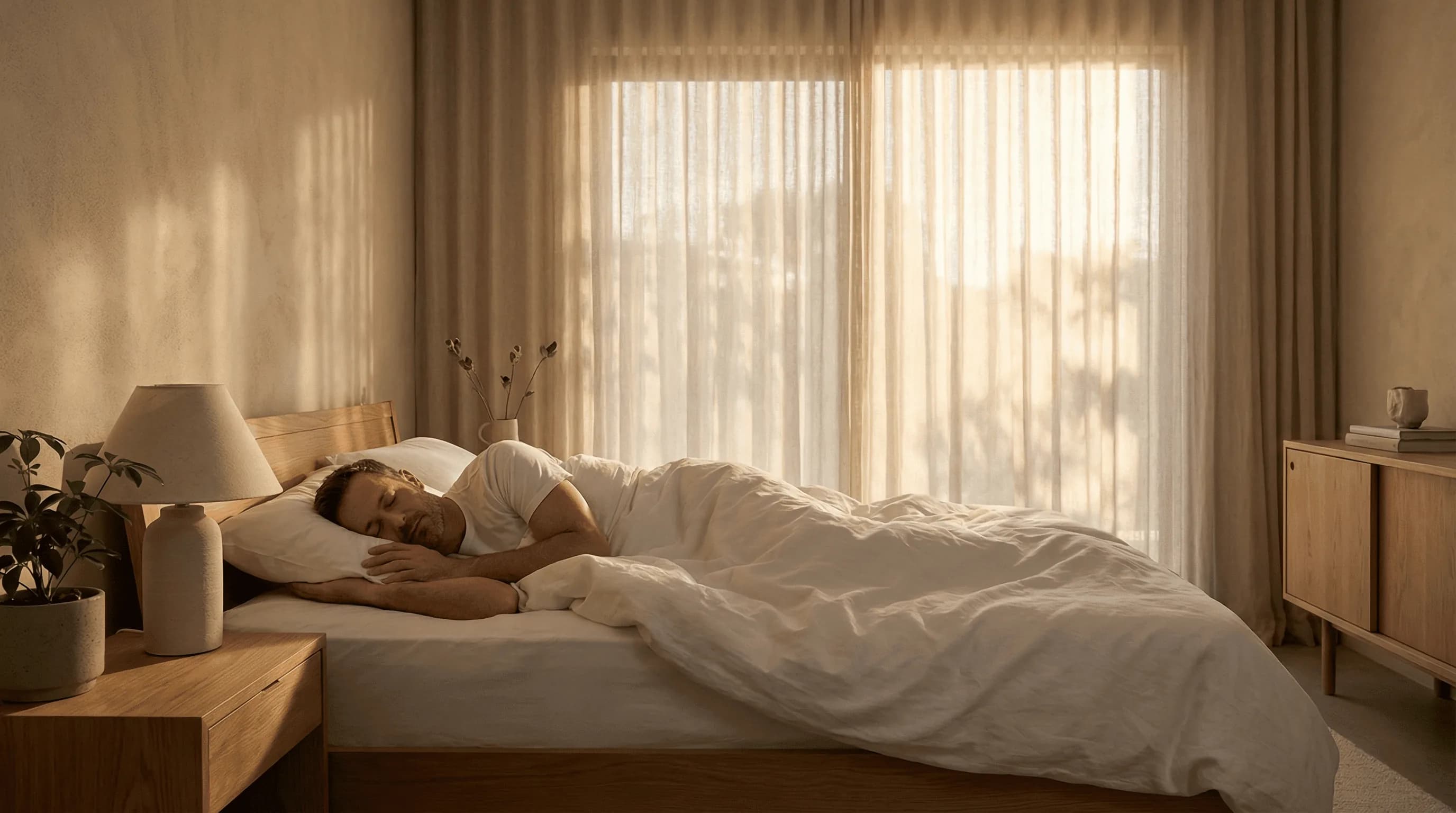

Most conversations about erectile dysfunction focus on the usual suspects, cardiovascular health, stress, age, or medications. Sleep rarely comes up. Yet sleep and erectile dysfunction are more tightly connected than most men realise, and the clinical evidence is hard to ignore.
If you're regularly getting fewer than six hours a night, or if your sleep quality is poor, broken, unrefreshing, or chronically delayed, it may be silently undermining your sexual health in multiple, overlapping ways. Understanding the mechanisms matters, because fixing them starts with knowing what's actually going wrong.
The Testosterone-Sleep Connection
Testosterone isn't a fixed quantity. It fluctuates throughout the day, and the biggest driver of that fluctuation isn't diet, exercise, or stress, it's sleep.
Research published in the Journal of Sexual Medicine has established that peak testosterone levels coincide with the onset of REM (rapid eye movement) sleep. Testosterone secretion begins rising at sleep onset and peaks during the first REM cycle, then tapers toward morning. The implication is significant: if your REM sleep is fragmented, delayed, or cut short, whether by sleep apnea, insomnia, or simply not spending enough hours in bed, your nightly testosterone surge may be blunted before it fully develops.
A 2025 study in the International Journal of Impotence Research (Nature Publishing) examined 249 young men presenting with erectile complaints and found that poor sleep quality and unfavourable chronotype (being an "evening type" whose natural sleep is consistently delayed) were independently associated with worse erectile function scores. Morning types had significantly better IIEF-5 scores compared to evening types, with the difference reaching statistical significance across all cohorts (p < 0.001).
The hormonal picture becomes clearer when you look at sleep disorders specifically. A large U.S. claims database analysis found that men diagnosed with insomnia had 30% higher odds of erectile dysfunction (OR 1.30), while circadian rhythm dysfunction was associated with 54% higher odds (OR 1.54). Sleep apnea, even at mild severity, independently predicted ED, a relationship likely mediated by both nocturnal hypoxia and disrupted testosterone secretion.
Nocturnal Erections: The Maintenance System You're Not Thinking About
Most men don't think about nocturnal penile tumescence (NPT), erections that occur during sleep, unless something draws attention to it. But NPT isn't a quirk of male biology; it appears to be a maintenance mechanism.
During sleep, particularly REM sleep, the body generates three to five erections per night. These erections deliver oxygenated blood to penile tissue, which is primarily smooth muscle. Without this regular nocturnal oxygenation, smooth muscle cells may undergo fibrotic changes over time, essentially, the tissue becomes stiffer and less capable of the engorgement required for a full erection during waking hours.
When sleep is disrupted, through fragmentation, short duration, or apnoeic episodes, the frequency and quality of NPT events decline. A 2026 study published in Nature: International Journal of Impotence Research specifically examined REM sleep fragmentation and its effects on erectile regulation, finding that disrupted sleep patterns were associated with blunted nocturnal testosterone secretion and reduced nocturnal erection quality, compounding the erectile impact of low testosterone.
The practical takeaway: poor sleep doesn't just make you feel less like sex. It may, over time, affect the physical health of the tissue involved.
The HPA Axis: How Sleep Deprivation Creates a Hormonal Cascade Against You
Sleep deprivation activates the hypothalamic-pituitary-adrenal (HPA) axis, the body's central stress response system. When HPA activity is chronically elevated, cortisol levels remain high into hours when they'd normally be low. Elevated cortisol suppresses gonadotropin-releasing hormone (GnRH), which in turn suppresses luteinizing hormone (LH), which directly reduces testosterone production.
The downstream effects extend to vascular function. Chronic cortisol elevation impairs endothelial nitric oxide synthase (eNOS), the enzyme that drives nitric oxide production. Nitric oxide is the primary vasodilatory signal for penile erection, without adequate NO release, the smooth muscle of the corpus cavernosum cannot fully relax, and engorgement is incomplete.
This is the chain: poor sleep → elevated cortisol → suppressed testosterone → reduced nitric oxide production → impaired erection quality. Each link in that chain is well-established independently; their convergence in the sleep-deprived male is what makes this relationship so clinically meaningful.
A comprehensive review published in PMC (Zhang et al.) specifically mapped these pathways and concluded that short sleep duration provokes HPA over-activity, autonomic nervous system imbalance, aberrant nocturnal erection patterns, and low testosterone, all independently contributing to erectile dysfunction.
Sleep Apnea: The Hidden Driver Many Men Don't Know They Have
Obstructive sleep apnea (OSA) deserves its own discussion because it affects an estimated 1 in 4 adult men and remains widely undiagnosed. OSA involves repeated partial or complete airway obstruction during sleep, causing intermittent hypoxia (oxygen drops) and sleep fragmentation, often without the sufferer ever fully waking.
The consequences for sexual health are significant. Research has shown that men with OSA have lower total and free testosterone, reduced sperm quality, and substantially higher rates of erectile dysfunction than matched controls. The mechanism is multi-factorial: hypoxic stress damages endothelial function, fragmented sleep blunts testosterone surges, and the chronic fatigue associated with OSA reduces libido and sexual confidence.
Continuous positive airway pressure (CPAP) therapy, the standard treatment for moderate-to-severe OSA, has been shown in clinical studies to improve erectile function, evidence that the ED in these cases is driven, at least in part, by the sleep disorder itself.
If you snore loudly, wake feeling unrefreshed, or have been told you stop breathing during sleep, OSA should be evaluated before attributing ED to other causes.
What You Can Do: Practical Sleep Optimisation for Erectile Health
The good news is that sleep quality is highly modifiable. Many of the interventions that improve sleep quality have direct, documented effects on hormonal health and erectile function.
Prioritise sleep duration. Most adults require seven to nine hours. Men sleeping under six hours show measurable testosterone suppression compared to those sleeping eight hours, a difference of 10–15% in some studies, significant enough to shift borderline-normal testosterone into the low range.
Protect REM sleep. REM sleep is most abundant in the final hours of your sleep window, which is why cutting sleep short, even if you "got enough", disproportionately reduces REM. Alcohol, while sedating, is particularly damaging to REM architecture and significantly suppresses nocturnal testosterone in a dose-dependent manner.
Address circadian consistency. Going to bed and waking at consistent times anchors your circadian rhythm. Irregular schedules, particularly the "social jetlag" pattern of staying up late on weekends, disrupt the hormonal sequence that sleep is supposed to deliver.
Evaluate for sleep apnea. If symptoms are present, a home sleep study is straightforward. Treating OSA has documented benefits for testosterone levels and erectile function.
Manage stress actively. Chronic psychological stress maintains elevated baseline cortisol that undermines both sleep quality and testosterone. Exercise, particularly resistance training, is one of the most effective interventions for both.
When Sleep Optimisation Isn't Enough
Sleep is foundational, but it isn't always sufficient. Even men with good sleep hygiene can experience ED driven by vascular, hormonal, or psychological factors that don't fully resolve with lifestyle change alone.
For men in this situation, clinically formulated options are available. OnyxMD's EPIQ CHEWS offer a daily chewable formulation combining Tadalafil 5mg with Vardenafil 5mg, a dual-PDE5 approach that supports consistent erectile function by maintaining baseline vasodilation through continuous daily use, rather than waiting for an on-demand dose. The addition of Vitamin D3 and K2 supports cardiovascular and endothelial health, addressing one of the underlying mechanisms that sleep deprivation and hormonal disruption affect.
This kind of daily, low-dose approach is particularly suited to men whose ED has a component of vascular or hormonal origin, which, given the research above, describes many men with chronic sleep issues.
Conclusion
The connection between sleep and erectile dysfunction is not incidental. Poor sleep suppresses testosterone, impairs nocturnal penile tumescence, activates chronic stress responses, and damages the vascular function on which erection depends. The clinical literature is consistent: men who sleep poorly are measurably more likely to experience erectile difficulties, and men who address their sleep often see meaningful improvements in sexual health.
Fix the sleep first. Then evaluate what else may be contributing.
If you're ready to explore clinically-formulated options, OnyxMD offers physician-supervised treatment plans starting with a free online assessment at questionnaire.getonyxmd.com.
These statements have not been evaluated by the FDA. This content is for informational purposes only and does not constitute medical advice.
Browse all articles | Learn more about EPIQ CHEWS
References
Cho JW, Duffy JF. "Sleep, sleep disorders, and sexual dysfunction." World Journal of Men's Health. 2019;37(3):261–275. doi:10.5534/wjmh.180045 PMID: 30209897
Wittert G. "The relationship between sleep disorders and testosterone in men." Asian Journal of Andrology. 2014;16(2):262–265. doi:10.4103/1008-682X.122586 PMID: 24435056
Gao Z, Yang D, Yu L, Cui Y. "Efficacy and safety of tadalafil in patients with obstructive sleep apnoea syndrome and erectile dysfunction after continuous positive airway pressure treatment." Journal of Sexual Medicine. 2012;9(8):2144–2150. doi:10.1111/j.1743-6109.2012.02820.x PMID: 22686832
Feldman HA, Goldstein I, Hatzichristou DG, et al. "Impotence and its medical and psychosocial correlates: results of the Massachusetts Male Aging Study." Journal of Urology. 1994;151(1):54–61. doi:10.1016/s0022-5347(17)34871-1 PMID: 8254833
Medical Disclaimer: The information provided on this website is for educational and informational purposes only and is not intended as medical advice. OnyxMD services should not be used to diagnose, treat, cure, or prevent any disease or medical condition. Always consult with a qualified healthcare provider before beginning any supplement regimen or health program.
FDA Disclaimer: These statements have not been evaluated by the Food and Drug Administration. This product is not intended to diagnose, treat, cure, or prevent any disease.
Individual Results: Results may vary. The experiences and testimonials presented on this website are individual results that may not be typical. Your experience may be different.
Telehealth Services: OnyxMD provides telehealth services in 47 states (excluding AK, MS, NJ) through licensed healthcare providers via our partner Beluga Health, P.A. Services are subject to clinical evaluation and may not be appropriate for all individuals. Prescriptions fulfilled by Strive Pharmacy LLC (License #99-9817) and EPIQ SCRIPTS LLC.