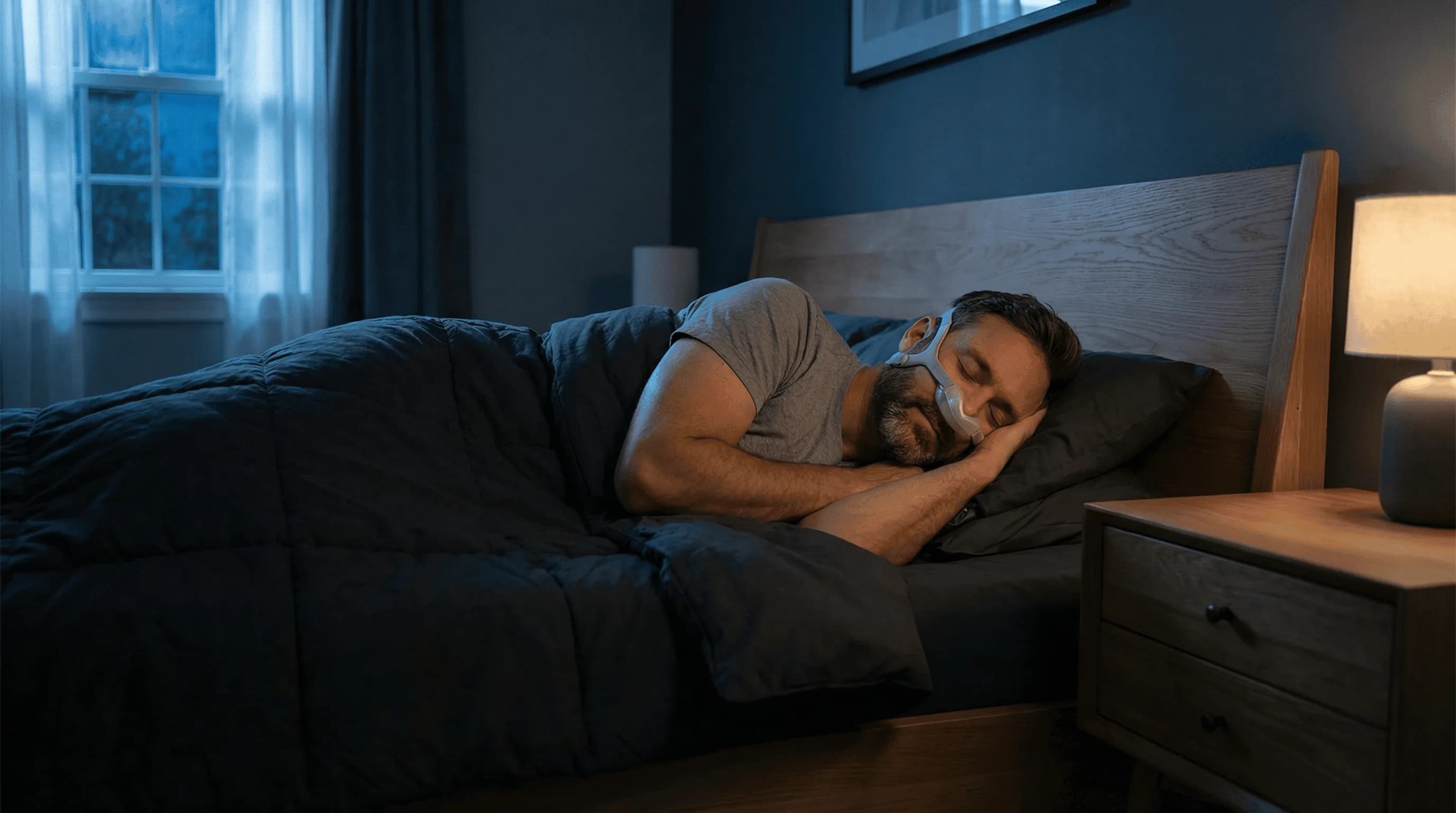

Sleep apnea and erectile dysfunction frequently coexist, but the connection is still underrecognized outside sleep medicine and urology. That is surprising, because the physiology of erection depends on exactly the systems obstructive sleep apnea tends to disrupt: endothelial function, nitric oxide signaling, testosterone regulation, autonomic balance, and restorative sleep architecture. For men with unexplained ED, especially those who snore loudly, wake unrefreshed, or have obesity, hypertension, or daytime fatigue, sleep-disordered breathing is not a fringe consideration. It is often one of the more biologically plausible contributors.
Why sleep quality matters for erections
An erection is not just a penile event. It is the result of coordinated neurologic, vascular, hormonal, and psychological signaling. Sexual stimulation activates central and peripheral neural pathways, nitric oxide is released into penile tissue, cavernosal smooth muscle relaxes, and arterial inflow rises while venous outflow is restricted. This process works best when endothelial cells are healthy, oxygen delivery is stable, and the autonomic nervous system can shift appropriately toward parasympathetic dominance.
Sleep is part of that system. Normal sleep supports testosterone secretion, blood pressure regulation, vascular repair, glucose metabolism, and nocturnal penile tumescence. Men usually experience several sleep-related erections during REM sleep. Those erections are not just incidental. They help maintain tissue oxygenation and smooth-muscle health within the corpora cavernosa. When sleep becomes fragmented or oxygen levels repeatedly fall overnight, the erectile system loses one of its routine maintenance cycles.
What obstructive sleep apnea does to the body
Obstructive sleep apnea (OSA) is characterized by repeated upper-airway collapse during sleep, causing intermittent hypoxia, arousals, swings in intrathoracic pressure, and recurrent sympathetic activation. In practical terms, the body spends the night alternating between partial suffocation, stress signaling, and incomplete recovery.
That pattern has consequences far beyond snoring. OSA is associated with hypertension, insulin resistance, endothelial dysfunction, systemic inflammation, mood symptoms, and higher cardiovascular risk. Those same conditions also cluster strongly around erectile dysfunction. The overlap is not accidental. The pathophysiology of OSA actively pushes the body toward the vascular and autonomic profile in which erections become less reliable.
A 2022 review in Frontiers in Psychiatry summarized this relationship clearly, concluding that the association between ED and OSA is supported by a growing body of evidence and that men presenting with ED may benefit from sleep evaluation. That point matters clinically because OSA is common, underdiagnosed, and often treatable.
The endothelial and oxygen story
The most direct mechanistic link between sleep apnea and erectile dysfunction is endothelial injury. Repeated intermittent hypoxia increases oxidative stress and reduces nitric oxide bioavailability. Nitric oxide is essential for erection because it initiates the smooth-muscle relaxation that allows blood to fill the penis. When endothelial nitric oxide signaling is impaired, penile hemodynamics become less efficient.
OSA also increases sympathetic tone. Erections require the body to downshift away from a stress-dominant state and allow parasympathetic pathways to drive vasodilation. Chronic nocturnal surges in catecholamines work against that. Over time, men with untreated OSA can end up in a physiologic pattern characterized by higher blood pressure, stiffer arteries, and poorer endothelial responsiveness, all of which are bad conditions for erectile reliability.
This is one reason ED is sometimes described as an early vascular marker. Penile arteries are smaller than coronary arteries, so vascular dysfunction may become noticeable during sex before it is obvious elsewhere. In a man with loud snoring, witnessed apneas, morning headaches, or excessive daytime sleepiness, ED can be a clue that the nightly oxygen problem is no longer just a sleep issue.
Prevalence data: ED is common in men with OSA
Clinical studies consistently find a high burden of erectile dysfunction among men with moderate to severe sleep apnea. In a 2024 study published in The Aging Male, Kim and colleagues evaluated 87 Korean men with OSA across four sleep centers using the International Index of Erectile Function (IIEF) before and after treatment. The authors describe ED as a prevalent issue in OSA that increases with age, reinforcing that this is not a rare secondary complaint but a common comorbidity worth screening for directly.
Older prospective work shows a similar pattern. In a 2019 Sleep Medicine study, Schulz and colleagues followed 94 men with severe OSA and found that 68.1% met criteria for ED at baseline using the IIEF-5. That prevalence is striking, but it is also biologically coherent. Severe OSA is exactly the setting in which intermittent hypoxia, blood pressure dysregulation, inflammation, and sleep fragmentation are most intense.
For men reading about this because they are trying to make sense of unexplained ED, the practical takeaway is simple: if erection problems coexist with snoring, obesity, resistant hypertension, or persistent daytime fatigue, OSA deserves consideration alongside the usual hormonal and cardiovascular workup.
Testosterone, REM sleep, and autonomic balance
Sleep apnea can also affect erections through hormonal and neuroregulatory pathways. Testosterone secretion is closely tied to sleep continuity and total sleep time, particularly the second half of the night. Repeated arousals and reduced REM sleep can blunt the normal nocturnal hormonal pattern. Not every man with OSA will have biochemical hypogonadism, but the hormonal environment can still become less supportive of libido, erectile confidence, and spontaneous morning erections.
REM disruption matters for another reason: REM sleep is when nocturnal erections commonly occur. These episodes are sometimes thought of as a diagnostic curiosity, but they also reflect the health of the neural and vascular systems involved in erection. Fragmented REM sleep reduces the opportunity for these maintenance cycles to occur.
At the same time, untreated OSA shifts the autonomic nervous system toward chronic sympathetic activation. Men may experience this as light, broken sleep, an exaggerated startle response on waking, or a sense of always feeling physiologically “on.” That is not an ideal backdrop for sexual function, which depends on the capacity to transition into a calmer parasympathetic state.
What happens when sleep apnea is treated
One of the most clinically useful questions is whether erectile function improves when OSA is treated. The evidence suggests that in at least some men, it does. In the 2024 The Aging Male study, IIEF scores improved significantly after three months of continuous positive airway pressure (CPAP) therapy. Interestingly, the investigators also found that quality-of-life measures influenced the degree of improvement, underscoring that sleep apnea affects both physiologic and psychological dimensions of sexual function.
The 2019 Sleep Medicine study reported a similar signal over a longer period. After 6 to 12 months of CPAP therapy, men with moderate and severe ED showed significant improvement in erectile function, and better quality of life tracked with that improvement. The authors noted that benefit may depend in part on CPAP adherence, which makes intuitive sense: the therapy can only help if it is actually reducing apneas and restoring oxygenation.
This does not mean CPAP is an ED treatment in the narrow sense. It means that correcting a major upstream driver of hypoxia, sympathetic activation, and sleep fragmentation may improve the physiologic conditions erections require.
When to suspect sleep apnea as an ED contributor
OSA is especially worth investigating in men who have ED plus any of the following: loud habitual snoring, witnessed breathing pauses, waking up choking or gasping, large neck circumference, obesity, hypertension, atrial fibrillation, morning headaches, or nonrestorative sleep. The suspicion should rise further if erectile symptoms are accompanied by daytime sleepiness or if a partner has noticed dramatic overnight breathing disruption.
The relationship is also important in younger men. When ED occurs earlier than expected, clinicians often focus on performance anxiety alone. Sometimes that is appropriate. But if a younger man is also severely sleep deprived, gaining weight, snoring heavily, and waking unrefreshed, a sleep study can be more informative than another round of reassurance.
For additional evidence-based reading on sexual health, vascular factors, and treatment pathways, browse the rest of our blog.
Conclusion
Sleep apnea and erectile dysfunction are linked through mechanisms that are both clinically plausible and increasingly supported by published evidence. Intermittent hypoxia, endothelial dysfunction, autonomic stress, hormonal disruption, and REM fragmentation all push erectile physiology in the wrong direction. The key practical point is that ED can sometimes be a downstream symptom of a sleep disorder that has gone undiagnosed for years. Identifying and treating OSA may improve not only sleep and cardiovascular health, but sexual function as well.
If you're exploring clinically-formulated options, OnyxMD offers physician-supervised treatment plans starting with a free online assessment at questionnaire.getonyxmd.com.
These statements have not been evaluated by the FDA. This content is for informational purposes only and does not constitute medical advice.
References
- Kim H, et al. Erectile dysfunction in patient with obstructive sleep apnea: effects of continuous positive airway pressure. The Aging Male. 2024;27(1):2317165. doi:10.1080/13685538.2024.2317165
- Schulz R, Bischof F, Galetke W, et al. CPAP therapy improves erectile function in patients with severe obstructive sleep apnea. Sleep Medicine. 2019;53:189-194. doi:10.1016/j.sleep.2018.03.018
- Gu Y, Wu H, Qin X, Yuan J. Erectile Dysfunction and Obstructive Sleep Apnea: A Review. Frontiers in Psychiatry. 2022;13:766639. doi:10.3389/fpsyt.2022.766639
Medical Disclaimer: The information provided on this website is for educational and informational purposes only and is not intended as medical advice. OnyxMD services should not be used to diagnose, treat, cure, or prevent any disease or medical condition. Always consult with a qualified healthcare provider before beginning any supplement regimen or health program.
FDA Disclaimer: These statements have not been evaluated by the Food and Drug Administration. This product is not intended to diagnose, treat, cure, or prevent any disease.
Individual Results: Results may vary. The experiences and testimonials presented on this website are individual results that may not be typical. Your experience may be different.
Telehealth Services: OnyxMD provides telehealth services in 47 states (excluding AK, MS, NJ) through licensed healthcare providers via our partner Beluga Health, P.A. Services are subject to clinical evaluation and may not be appropriate for all individuals. Prescriptions fulfilled by Strive Pharmacy LLC (License #99-9817) and EPIQ SCRIPTS LLC.